

Understanding aged care fees and your payment options.
Understanding aged care fees
Residential aged care fees at Superior Care Group are made up of care fees and an accommodation payment, which can be paid as a refundable lump sum, a daily payment, or a mix of both. Knowing how fees and payment options work helps you make the best decision for your family. The cost is made up of two fees:

Two types of fees
- 1. Daily Care Fee: set by the Australian Government and charged daily for your aged care services.
- 2. Accommodation Fee: the cost of the suite you choose at your residence.

The Daily Care Fee
Charged day by day, the Daily Care Fee has three parts:
The Department of Human Services then decides if the fee applies, until an annual or lifetime cap is reached.
- 1. Basic Daily Care Fee: paid by every resident and set by the government at about 85% of the single Age Pension.
- 2. Means Tested Care Fee: based on a government assessment of your income and means. My Aged Care’s short questionnaire shows whether you need to complete the Income and Means Assessment Form.
- 3. Additional Services Fee: a daily fee for extras such as meal choices and enhanced lifestyle and activity options.
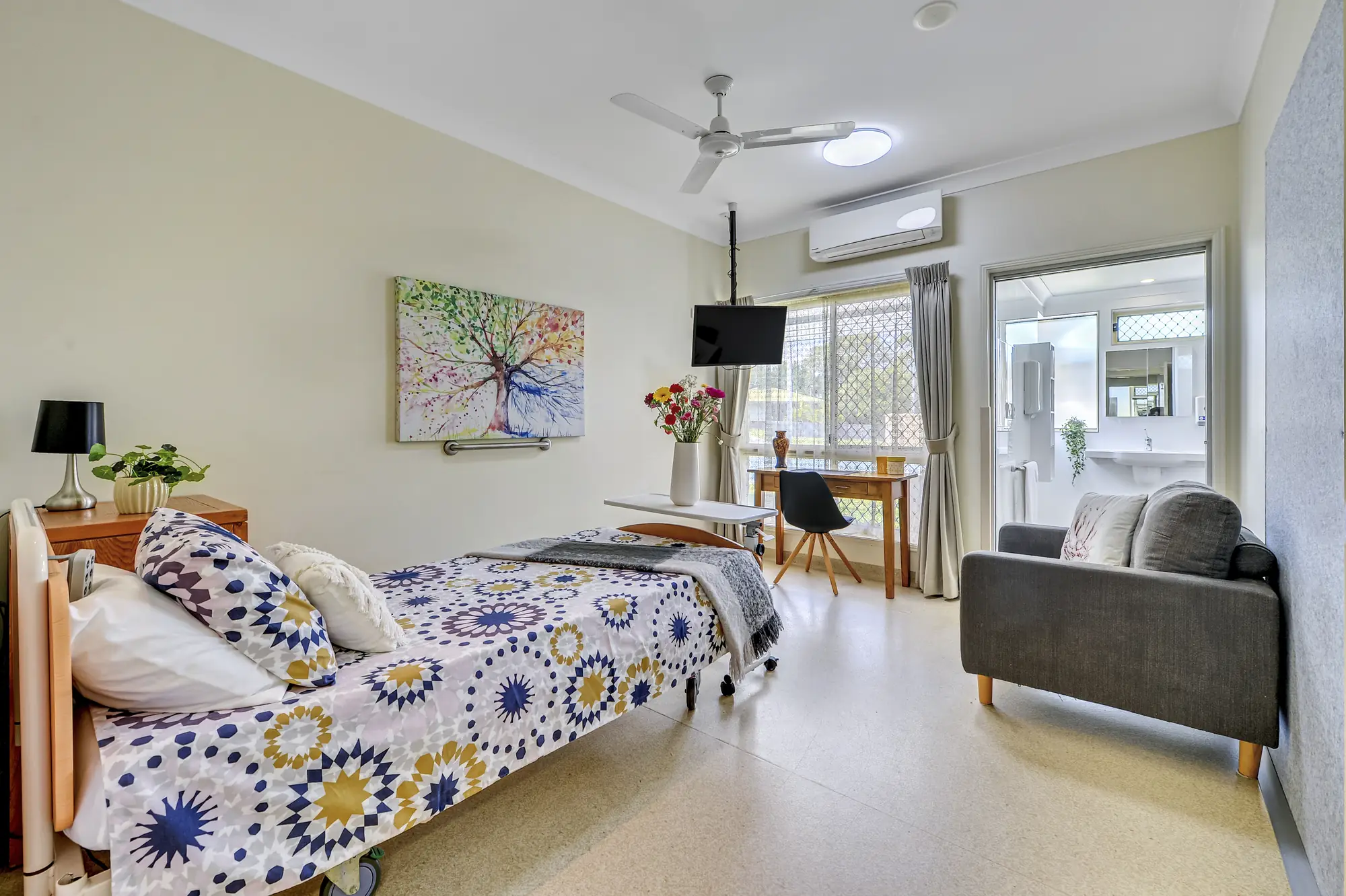
Accommodation payments
Accommodation payments vary with the suite you choose. There are three ways to pay:
- Lump sum (RAD): paid when you move in, based on your suite, and fully refundable when you leave.
- Daily payment (DAP): a daily fee calculated from the RAD at the government set interest rate. No lump sum is paid and nothing is refunded.
- Combination: pay part as a RAD and the rest as a DAP, calculated on the outstanding RAD amount.
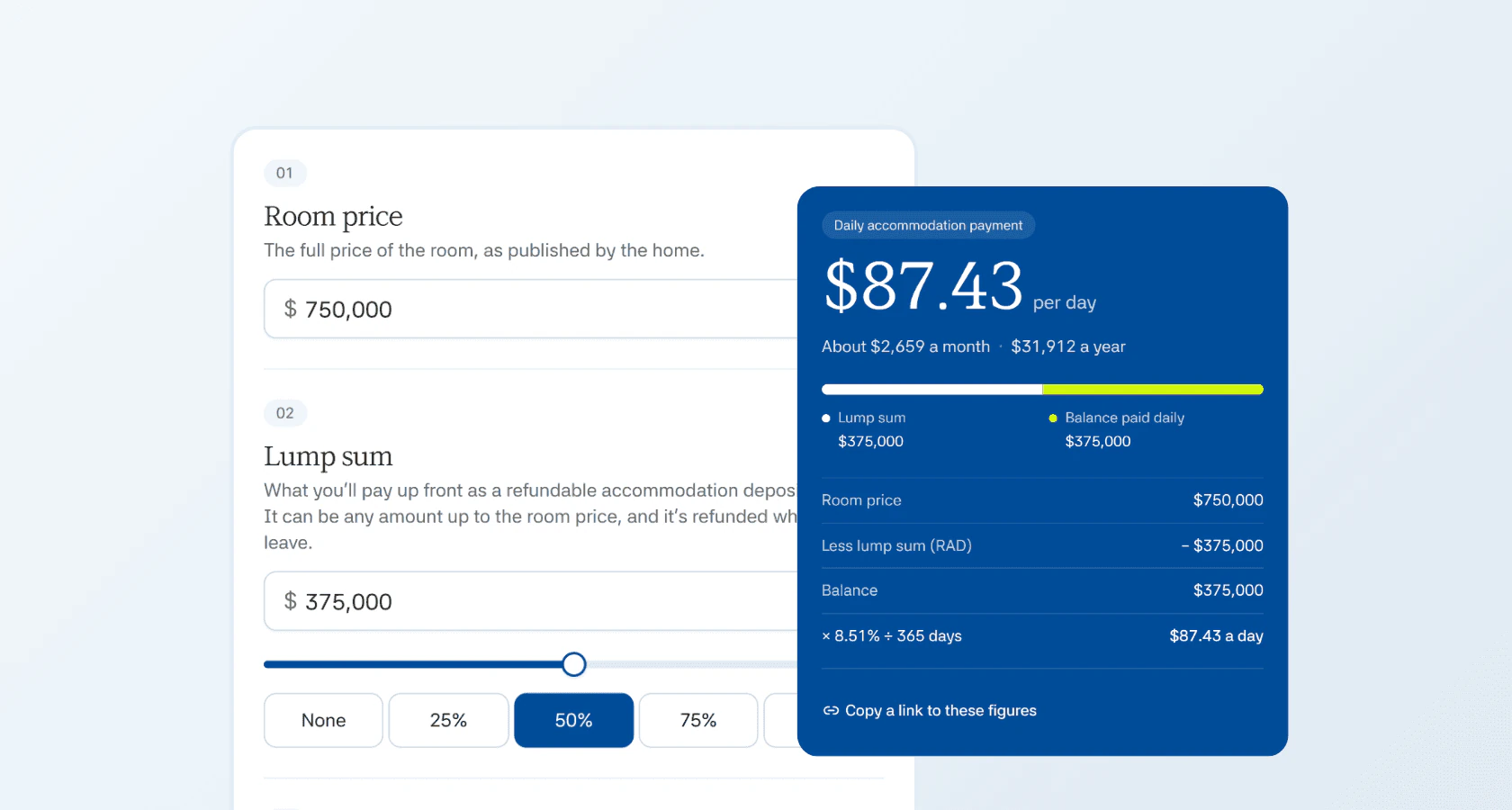
Work out your daily accommodation payment
Enter the room price and how much you’d like to pay as a lump sum. We’ll work out the daily payment on the rest, using the government’s current interest rate.
You ask,
we answer.
How do I know how much RAD to pay?
The RAD amounts for each room type can be found on our website by clicking on the "Accommodation" link on each residence page. There is also the option for fully or partially supported accommodation, which can provide a subsidy on the RAD amount depending on financial situation. Services Australia (Centrelink) determines if an individual qualifies for support or needs to make an accommodation payment based on the Income and Means Assessment form. My Aged Care has a short questionnaire to determine if the form needs to be completed, and can provide more information and steps to take based on the answers. Click here to complete the questionnaire. For assistance, call Services Australia (Centrelink) on 1800 227 475, My Aged Care on 1800 200 422, or the Department of Veteran Affairs on 133 254. For those in need of support, Aged Care can include 24-hour nursing care and the goal is to enable older individuals to maintain independence as much as possible, with support tailored to individual needs and preferences.
Does the RAD need to be paid upon entry to a Superior Care residence?
The government allows a six-month period from the date of entry to pay the full RAD balance, with added interest paid at the current legislated rate until the full amount is paid. If the RAD is paid within 7 days of entry, no interest will be charged.
Is the RAD safe and what happens if a resident leaves or passes away?
The government guarantees all Refundable Accommodation Deposits (RADs) paid to Superior Care. If the resident leaves a Superior Care residence, the RAD is fully refunded to the resident or their estate, minus any outstanding fees, charges, or interest. If the resident decides to return home, the RAD is refunded within 14 days of discharge. If the resident passes away, the RAD will be refunded to their estate within 14 days of receiving a certified copy of the Grant of Probate.
What type of accommodation options are available?
There are three types of accommodation available within Superior Care's aged care residences: 1. Fully Government supported accommodation These are suites where no accommodation payment is required and determined by Services Australia (Centrelink) based on the Income and Means Assessment form. My Aged Care has a short questionnaire that will let you know whether you need to complete the Income and Means Assessment form or whether Services Australia (Centrelink) can complete it for you based on your answers. Upon completing the questionnaire, it will provide you with more information and steps to take based on your answers. Click here to complete this questionnaire. 2. Partially Government supported accommodation These are suites where only a small accommodation payment is required and determined by Services Australia (Centrelink) based on the Income and Means Assessment form. Services Australia (Centrelink) determines if someone qualifies as partially supported based on the information provided in the completed Income and Means Assessment form. My Aged Care has a short questionnaire that will let you know whether you need to complete the Income and Means Assessment form or whether Services Australia (Centrelink) can complete it for you based on your answers. Upon completing the questionnaire, it will provide you with more information and steps to take based on your answers. Click here to complete this questionnaire. 3. Standard accommodation These are the majority of aged care suites available at our residences and are subject to an accommodation payment payable by the resident. Each suite has a set price that is primarily determined by the suite's features and location, the residence's location and housing prices in the area. The payment can take the form of RAD, DAP, or a combination of these.
Does the family home need to be sold before I enter into Aged Care?
Whether or not the family home needs to be sold to enter aged care depends on each individual case. It is not always necessary to sell the home. An individual's financial situation will determine if it is needed. Seeking financial advice is recommended to determine the best financial outcome. Keep in mind that an individual's financial structure may impact their pension and means tested care fee.
Are there any additional aged care costs?
Yes. Residents are responsible for paying for all medication costs, which will be billed directly by the pharmacy. We will inform if allied health costs (such as podiatry and physiotherapy) will be an additional cost or covered by the government. In general, those with low care needs will be required to pay these costs, while those with higher level care needs will have the costs covered by Superior Care. Other additional costs may depend on the extra amenities that the resident would like to enjoy at the Superior Care residence home, such as telephone hairdresser and beauty salon. Superior Group charges all residents an additional $30 per day Additional Services fee for our inclusive package of hotel meals, beverages, air conditioning, wireless internet and premium lifestyle program.
How do I lodge an Income and Means Assessment form?
After completing the questionnaire on My Aged Care, it will inform you if you need to complete the Income and Means Assessment form or if Services Australia (Centrelink) will complete it on your behalf. If you need to complete the form, it can be downloaded after the questionnaire. Once completed, it should be submitted to Services Australia through online submission, visiting a Centrelink/Services Australia office or by mail. These instructions are available on the last page of the form. Services Australia (Centrelink) will determine if a prospective resident needs to pay a means-tested care fee in addition to the Basic Daily Care Fee and Superior Care Additional Services Fee.
What if my aged care financial question is not on here?
If you have any additional questions please get in touch and we will be happy to help answer them for you. Our dedicated Centre Managers can provide you with brochures from a number of financial advisors who specialise in aged care.